Showing posts with label politics. Show all posts

Wednesday, April 27, 2011

Obama and the Birthers


Obama released his birth certificate today. Whew. Now hopefully these Bigfoot conspiracy theorists turned political hounds can FINALLY shut up about this and the perpetual nonsense can FINALLY stop. Uh...maybe not. As I've been trolling message boards, blogs and Facebook eagerly looking for the opportunity to drop the smug "I told you so" whenever and wherever possible, imagine my surprise to see that this issue is FAR from over.

In fact, what should have ultimately stamped out the crazy only seems to have transformed it into Crazy 2.0. I really don't know how to respond when evidence is rejected simply because it doesn't confirm your position. That's like religion. Oh wait. We are dealing with the Religious Right here. Okay now it makes a little more sense. Well maybe "makes a little more sense" is the wrong way to phrase that...

Dostoyevsky once penned: “Man has such a predilection for systems and abstract deductions that he is ready to distort the truth intentionally, he is ready to deny the evidence of his senses only to justify his logic.”

See, that's what I meant by "makes a little more sense."

I frequently get accused of doing that which I call others out for, namely, pulling party line regardless of the situation. You know, like Republicans requiring a different standard of Obama (produce your Birth certificate, school records, "made in the usa" baby-binkie from his infancy, etc) than has been required of any President yet.

Although, I'll grant you that the GOP did thoroughly reject Romney for his Mormonism almost as bad as they did for Obama being a Muslim. Of course, the big difference there is that Romney actually is a Mormon...

Anyhow, to prove I'm not a party-liner, let me propose a scenario and how I would react.

Let's assume Sarah Palin wins the next election and becomes President (come on, take a hit from a bong if that's what it takes for you to take this imaginary journey with me) of the United States of America.

Let's also assume that the Democrats learn from the Republican's masterful political strategies and they embrace MSNBC as their official media propagandizing mechanism. The Dems, in conjunction with every MSNBC talk show host, begin a brutal smear campaign of President Palin, attacking her level of mental intelligence. They focus on questioning her intelligence for believing that the earth is 6,000 years old. Word leaks that a "Palin IQ Test" exists. Grass-roots organizations generate pressure for her to make public her IQ test score to prove her mental competency is above levels of those we generally consider "unaccountable for their actions."

The Palin administration ignores this based upon the idiocy of the issue at hand but these neanderthal grass-root patriotic Democrats just want answers. There is an easy solution. Just reveal the IQ test results. If there is nothing to hide why hasn't President Palin released the results? She becomes so bogged down with the insanity of the people she has been elected to govern that she finally just decides to release them. Issue over?

No, of course, not. The evil puppet-masters that are pulling her strings have obviously just had time to fake the test results to show that she shouldn't be wearing a helmet in her day-to-day activities.

I want you Birthers to know that this is EXACTLY how I think you come off to the normal people of the world. However, in the (hopefully) improbable case that this scenario actually comes to pass - Just know that I will be equally outspoken in her defense as I am with this ludicrous birther issue.

Tuesday, March 8, 2011

GOP Conservative FAIL

If you haven't heard the Right consistently bemoan how the Obama administration is spending astronomical figures (which I agree, they are) then you either don't pay attention to current events or...well, I don't have an "or" for you.

My issue with these elected "conservatives" is that they are knowingly hypocritical and don't seem to care about it. I have four theories:

1. They know their constituents aren't smart enough to recognize the hypocrisy
2. Their constituents share their hypocrisy
3. They know their constituents care about being on the winning team more than holding them accountable for their hypocrisy.
4. Being 1.6% better than Democrats is the lesser of two evils (You'll understand the 1.6% by the end of this).

We have seen signs like this for the last few years decrying Obama's budget proposals:


I'm not going to turn this into a "Who-Breaks-More-Promises" because it is plain as day that both sides do. I won't even argue about the "Spend to get out of debt" methodology. I have heard how Americans are sick and tired of the Obama administration's out of control spending. I have been told "American has spoken" regarding the Republican's regaining of the House. Now this shit will end and we will get America back on track.

While there is so much to rant about what they've done so far, I promise to stay on target. Our focus will be to evaluate and discuss how they have dealt with the proposed budget. I really just don't understand why red-blooded Americans cannot see that the elected Republicans just are NOT that different when it comes to fiscal conservatism. The evidence just doesn't support their assertions.

John Boehner, Speaker of the House, and defacto Republican tanned poster boy, issued the promise to his constituents and America that (insert dramatic music here) "The American people have directed us to cut spending. We will. And there’s no limit to the amount we’re willing to cut to help get our economy moving again. Let me be very clear about this: we are going to exceed our Pledge to America. We are going to cut $100 billion in discretionary spending next week. Write it down. $100 billion in discretionary spending. And we aren’t going to stop there."

Wow. Now, while $100 billion does sound like a lot, I want you to consider something. The Obama administration's proposed budget was roughly $3.8 trillion. I'm going to write it out because it's more dramatic to see the zeroes.

$3,800,000,000,000

What is the deficit you ask? Excellent question. It was forecast at $1.5 trillion but is expected to end around $1.6 trillion.

So, with the $2,200,000,000,000 that we have as revenue/cash flow, we then spend $1,600,000,000,000 more than we have. I wish my home budget could work with that math.

Now, the Republicans ran on the premise of (rightly) pointing out the illogical nature of this methodology and promising change. Sound familiar? So they won the elections, took office and have now promised that to solve this problem, they will reduce spending by $100 billion. They promised to reduce the proposed budget by 2.6%.

Then they failed.

These fiscal conservatives decrying Obama's socialism couldn't even cut out 2.6%. They initially came in a little over $30 billion but the outrage amongst many of their own party not wanting to fail the "Tea Party Movement" base of supporters caused them to get that number up to around $60 billion. Still 40% below Boehner's "Read my Lips" promise. This Republican plan still leaves a $1.54 trillion dollar deficit.

So here is my question:

How is 1.6% less than what the Kenyan Muslim Socialist destroyer of America proposed somehow good conservative Republicanism? Or is it just good old American political hypocrisy?

Sunday, February 27, 2011

Obama, DOMA and the Constitution

There are so many different issues regarding the Obama Administration’s decision not to defend the constitutionality of the Defense of Marriage Act. And to be accurate, he has only instructed that cases pertinent to Section 3 of the Act will be subverted. "...the word 'marriage' means only a legal union between one man and one woman as husband and wife, and the word 'spouse' refers only to a person of the opposite sex who is a husband or a wife."

From the liberal butt-kissing support to the neo-con priestcraft, the misinformation has spread faster than wildfire. It would take volumes to address it all. I want to discuss one individual aspect, and just the one.

Does President Obama (or any past or future President) have an obligation to defend laws they believe to be unconstitutional?

On January 20th (and the 21st), President Obama recited the Presidential oath of office: “I do solemnly swear (or affirm) that I will faithfully execute the Office of President of the United States, and will to the best of my ability, preserve, protect and defend the Constitution of the United States.”

The President did NOT swear to support the Defense of Marriage Act. Even if I concede and give the former Congress the benefit of the doubt in stipulating that they upheld their Congressional oath by enacting DOMA, which between you and I, would be a lie. Nonetheless, let's hypothetically give them that benefit. The President is not oath-bound to defend or protect their decision.

This is not the first time, nor will it be the last when a President refuses to defend the constitutionality of a law or statute. His duty to uphold the Constitution supersedes his obligation to enforce federal statutes when the two come into conflict. Federal statutes are only legitimate if they are constitutional.

The Executive, Judicial and Legislative branches of our government each bears an independent responsibility to analyze the constitutionality of current and proposed laws. However, the Executive and Legislative branches are Constitutionally bound to obey Judicial decisions that address a statute but if the courts have not yet ruled on the issue, nothing prevents the President or Congress from making a considered independent judgment that the statute is nonetheless unconstitutional and acting accordingly.

In his role, if the President truly believes that DOMA is unconstitutional as he says, then he is at the very least duty-bound to defer prosecutions until the courts have had their say. However, the Obama Administration has made clear their position that they believe it to be unconstitutional, thus paving the way for a show down at the Supreme Court.

So to say that President Obama's actions are unconstitutional, or un-American, well the opposite couldn't be more true than on this issue as he attempts to "protect, preserve and defend the Constitution of the United States.”

Sunday, February 6, 2011

Did Oaks Really Used to Sit on the Utah Supreme Court?

I just read a disturbing article on the recent speaking engagement of Dallin H. Oaks at the Chapman University Law School. "We must never see the day when the public square is not open to religious ideas and religious persons," Elder Oaks said. Now if he would have just stopped there...I'd be okay. Well, sort of. As long as Oaks realizes that the public square is NOT like his Church in which opposing ideas are not subject to criticism. When religion is used as the motivating premise behind proposing, or establishing, legislation then the prosecution has opened the door for rebuttal questioning.

Unfortunately, Oaks did not just stop there. "The religious community must united to be sure we are not coerced or deterred into silence by the kinds of intimidation or threatening rhetoric that are being experienced." Really? Religious people are being forced into silence by intimidation and threatening rhetoric? Mr Oaks...your Church has led the charge in multiple states to create Constitutional amendments defining marriage as between "one man and one woman." 30 of the 50 states have created "separate but equal" legislation. And your whining over alleged "threatening rhetoric?"

Elder Oaks cited a number of religiously diverse examples and leaders in highlighting his four points on preserving religious freedom:

1. Religious teachings and religious organizations are valuable and important to a free society, thus "deserving of their special legal protection."
**My thoughts: Prove it. Prove that religious teachings and religious organization are important to a free society. I think morality exists outside of established tax-free corporations run by religious officers. We'd do fine without them.

2. Religious freedom "undergirds the origin and existence of this country and is the dominating civil liberty."
**My thoughts: I absolutely agree but not if the reader assumes Oaks is saying that the United States was established as a Christian nation. I agree that one of the foremost reasons this country was established was to promote freedom, including the freedom of religion. However, the phrase "the dominating civil liberty" is a bit extreme considering it was the religious text of the early Christian founders that allowed slavery to exist for as long as it did. The phrase is also somewhat ironic coming from an "apostle" whose Church didn't promise the opportunity for exaltation to black members until 1978.

3. The constitutional guarantee of free exercise of religion "is weakening in its effects and in public esteem."
**My thoughts: Bullshit. I'd really like to hear how the opportunity for religious worship is suffering. Public esteem in religion is suffering because people are using their noodles. Public esteem in the constitutional rights of the free exercise of religion are not suffering, public esteem in the constitutional rights of tax-exempt status of religious organizations that use their influence to suppress constitutional rights of legal citizens is suffering.

4. Such a weakening can be attributed "to the ascendancy of moral relativism."
**My thoughts: "Meta-ethical relativism is the meta-ethical position that the truth or falsity of moral judgments is not objective. Justifications for moral judgments are not universal, but are instead relative to the traditions, convictions, or practices of an individual or a group of people. The meta-ethical relativist might say "It's moral to me, because I believe it is." Hypocrisy again. It applies to others but not to me.

Oaks continues: "Religious individuals should insist on their constitutional right and duty to exercise their religion, to vote their consciences on public issues and to participate in elections and debates." Mr Oaks, individuals do have a constitutional right to exercise their religion. There is NO CONSTITUTIONAL DUTY to exercise a religion. Individuals are allowed to vote their consciences on public issues and participate in elections and debates. However, there is NO CONSTITUTIONAL PROTECTION that says religious thought must win those elections and debates, nor is your voicing your conscience in public forums protected from scrutiny.

"All who believe in that fundamental should unite more effectively to preserve and strengthen the freedom to advocate and practice our religious beliefs, whatever they are," he said. "We must walk together for a ways on the same path in order to secure our freedom to pursue our separate ways when that is necessary according to our own beliefs." **Great, do it. That is a Constitutional right. Maybe the former Utah Supreme Court justice is learning after all...eyeroll.

"I speak for a broader principle, nonpartisan and, in its own focused objective, ecumenical," he said. **Well, ecumenical unless you're someone that God tells us to legislate against...

Okay, you ready, because here is where I really get pissed at someone who either knows better or cheated his way onto the state Supreme Court.

"Along with many others, I see a serious threat to the freedom of religion in the current assertion of a 'civil right' of homosexuals to be free from religious preaching against their relationships. Religious leaders of various denominations affirm and preach that sexual relations should only occur between a man and a woman joined together in marriage. One would think that the preaching of such a doctrinal belief would be protected by the constitutional guarantee of the free exercise of religion, to say nothing of the guarantee of free speech. However, we are beginning to see worldwide indications that this may not be so."

As a private religious organization, you have EVERY Constitutional right to continue your religious preaching against homosexual relationships. Why can't you just be honest and say that your feelings are hurt because of the backlash that church is receiving and that your PR department is working round the clock to try and save your asses.

Let's go a step further and say that your real concern is regarding your tax-exempt status as a religious organization. However, the crux behind that is the apparent inability of the LDS Church to accurately disclose to the IRS how much was actually donated to the YES on 8 cause. Well, I think your third submission might be close.

Oaks also took exception to the suggestion by President Barack Obama's head of the Equal Employment Opportunity Commission that a "sexual-orientation liberty" could become such a right that it should prevail over a competing "religious-belief liberty."

"Such a radical assertion should not escape analysis," Elder Oaks said, because it condemns the notion of a centuries-old fundamental right of freedom of religion to becoming recast as a simple "liberty" ranked among many other liberties. It also would create sexual orientation as a fundamental right called "sexual liberty" and to the conclusion that religious expressions can be overridden by a fundamental right to "sexual liberty."

Hmmm....what is Oaks really saying? Okay, as a Church with tax-exempt status, a private organization, it is legal to discriminate any which way a bigot chooses. However, the for-profit corporations owned by the Church do not have such luxuries...hence, all of the for-profit corporations owned and operated by the Church (if same-sex couples can similar rights), would be forced to treat gays as equals under Constitutional protection. Can you imagine Deseret News had to offer domestic partner benefits?

"All of this shows an alarming trajectory of events pointing toward constraining the freedom of religious speech by forcing it to give way to the 'rights' of those offended by such speech," Elder Oaks said. "If that happens, we will have criminal prosecution of those whose religious doctrines or speech offend those whose public influence and political power establish them as an officially protected class."

This is probably the 2nd most inflammatory load of shit in his article. Homosexuals, and free-thinkers alike, are "offended by such speech." However, it is not the offended status of those listening to your constitutionally protected hate speech that causes gays to gain rights...it is the same Constitution that you as a state Supreme Court Justice swore an oath to uphold.

"I, Dallin H. Oaks, do solemnly swear (or affirm) that I will administer justice without respect to persons, and do equal right to the poor and to the rich, and that I will faithfully and impartially discharge and perform all the duties incumbent upon me as (name of position) under the Constitution and laws of the United States. So help me God.”

Maybe you need to work on a constitutional amendment for Judges so that it can read "...administer justice without respect to persons...except for those we disagree with religiously..." For all of the talk about protecting the Constitution, without fail the Religious Right has done more to destroy and pervert the Constitution than all of the godless liberals.

Wednesday, December 29, 2010

Separation of Church and State?

This is a taken from a Huffington Post article posted today. I just found it interesting and figured some of you would too.

The Public Religion Research Institute (PRRI) team put our heads together and came up with the following top religion and politics research findings in 2010. These issues are sure to follow us into the new year. Let us know in the comment stream what you would add to the list.

1. Nearly half (47 percent) of Americans who identify with the Tea Party movement also identify with the Christian right.

2. Pew found that nearly 1-in-5 (18 percent) Americans wrongly believe President Obama is a Muslim, and PRRI found a majority (51 percent) say his religious beliefs are different from their own.

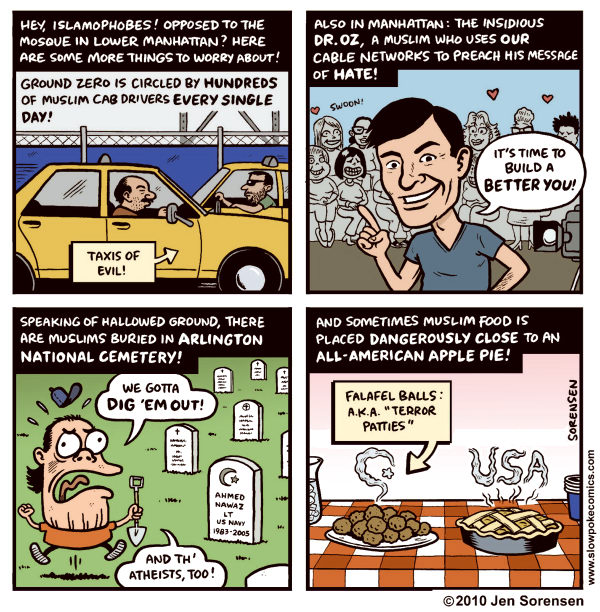
3. Fifty-seven percent of Americans are opposed to allowing NY Muslims to build an Islamic center and mosque two blocks from ground zero, but 76 percent say they would support Muslims building a mosque in their local community if they followed the same regulations as other religious groups.

4. Americans are about five times more likely to give an "F" (24 percent) than an "A" (5 percent) to churches for their handling of homosexuality. Two-thirds see connections between messages coming from America's churches and higher rates of suicide among gay and lesbian youth.

5. Forty-five percent of Americans say the values of Islam are at odds with American values and way of life, while a plurality (49 percent) disagree.

6. If another vote similar to Proposition 8 were held now, a majority (51 percent) of Californians say they would vote to allow gay and lesbian couples to marry.

7. At least 7-in-10 Americans say that protecting the dignity of every person (82 percent), keeping families together (80 percent), and the Golden Rule are important values that should guide immigration reform (71 percent).

8. In his new book American Grace, Robert Putnam found that between one-third and one-half of all American marriages are interfaith marriages, and roughly one-third of Americans have switched religions at some point in their lives.

9. Despite high levels of religiosity, Pew found on average that Americans only answered about half of 32 questions correctly on their Religious Knowledge Survey.

10. The 2010 congressional election revealed relatively stable voting patterns by religion compared to past elections. GOP candidates held an advantage among white Christians, while Democratic candidates held an advantage among minority Christians and the unaffiliated.

And 11 for 2011. Nearly 6-in-10 Americans affirm American exceptionalism, that God has granted America a special role in human history. Those affirming this view are more likely to support military interventions and to say torture is sometimes justified.

Robert P. Jones, Ph.D., CEO and Founder of Public Religion Research Institute.

Friday, September 17, 2010

1st Amendment Rights

Freedom of speech does not mean one's speech is free from criticism or consequences.

Criticism: Not on the basis of one's right so say what they wish but on the basis that what was said can be countered or proven false with logic and reason.

Consequences: When a company or organization supports a candidate or legislation, they run the risk of gaining or losing customers who can exercise their rights as consumers to support or boycott them for their public positions.

For those who then cry foul for either of these two reasons, I mockingly laugh at your perceived suffering.

Monday, September 6, 2010

Chris Hitchens Article on Free Exercise of Religion

(thanks to Chris, Jake and Ryan for all sending me this link on the same day...lol)

"Free Exercise of Religion? No, Thanks."

The taming and domestication of religious faith is one of the unceasing chores of civilization.

By Christopher Hitchens

Posted Monday, Sept. 6, 2010, at 11:39 AM ET

A recent blizzard of liberal columns has framed the debate over American Islam as if it were no more than the most recent stage in the glorious history of our religious tolerance. This phrasing of the question has the (presumably intentional) effect of marginalizing doubts and of lumping any doubters with the anti-Catholic Know-Nothings, the anti-Semites, and other bigots and shellbacks. So I pause to take part in a thought experiment, and to ask myself: Am I in favor of the untrammeled "free exercise of religion"?

No, I am not. Take an example close at hand, the absurdly named Church of Jesus Christ of Latter-day Saints. More usually known as the Mormon church, it can boast Glenn Beck as one of its recruits. He has recently won much cheap publicity for scheduling a rally on the anniversary of Martin Luther King Jr.'s March on Washington. But on the day on which the original rally occurred in 1963, the Mormon church had not yet gotten around to recognizing black people as fully human or as eligible for full membership. (Its leadership subsequently underwent a "revelation" allowing a change on this point, but not until after the passage of the Civil Rights Act.) This opportunism closely shadowed an earlier adjustment of Mormon dogma, abandoning its historic and violent attachment to polygamy. Without that doctrinal change, the state of Utah was firmly told that it could not be part of the Union. More recently, Gov. Mitt Romney had to assure voters that he did not regard the prophet, or head of the Mormon church, as having ultimate moral and spiritual authority on all matters. Nothing, he swore, could override the U.S. Constitution. Thus, to the extent that we view latter-day saints as acceptable, and agree to overlook their other quaint and weird beliefs, it is to the extent that we have decidedly limited them in the free exercise of their religion.

One could cite some other examples, such as those Christian sects that disapprove of the practice of medicine. Their adult members are generally allowed to die while uttering religious incantations and waving away the physician, but, in many states, if they apply this faith to their children—a crucial element in the "free exercise" of religion—they can be taken straight to court. Not only that, they can find themselves subject to general disapproval and condemnation.


It was probably the latter consideration that helped impel the majority of American Orthodox Jews to give up the practice of metzitzah b'peh, a radical form of male circumcision that is topped off, if you will forgive the expression, by the sucking of the infant's penis by the rabbi or mohel so as to remove any remaining blood or debris. A few tiny sects still cling to this disgusting ritual, which in New York a few years ago led to a small but deadly outbreak of herpes among recently circumcised babies. On that occasion, despite calls for a ban on the practice from many Jewish doctors, the vastly overrated Mayor Michael Bloomberg chose an election year to say that such "free exercise" should not be interfered with.

We talk now as if it was ridiculous ever to suspect Roman Catholics of anything but the highest motives, yet by the time John F. Kennedy was breaking the unspoken taboo on the election of a Catholic as president, the Vatican had just begun to consider making public atonement for centuries of Jew-hatred and a more recent sympathy for fascism. Even today, many lay Catholics are appalled at the Vatican's protection of men who are sought for questioning in one of the gravest of all crimes: the organized rape of children. It is generally agreed that the church's behavior and autonomy need to be modified to take account both of American law and American moral outrage. So much for the naive invocation of "free exercise."

One could easily go on. The Church of Scientology, the Unification Church of Sun Myung Moon, and the Ku Klux Klan are all faith-based organizations and are all entitled to the protections of the First Amendment. But they are also all subject to a complex of statutes governing tax-exemption, fraud, racism, and violence, to the point where "free exercise" in the third case has—by means of federal law enforcement and stern public disapproval—been reduced to a vestige of its former self.

Now to Islam. It is, first, a religion that makes very large claims for itself, purporting to be the last and final word of God and expressing an ambition to become the world's only religion. Some of its adherents follow or advocate the practice of plural marriage, forced marriage, female circumcision, compulsory veiling of women, and censorship of non-Muslim magazines and media. Islam's teachings generally exhibit suspicion of the very idea of church-state separation. Other teachings, depending on context, can be held to exhibit a very strong dislike of other religions, as well as of heretical forms of Islam. Muslims in America, including members of the armed forces, have already been found willing to respond to orders issued by foreign terrorist organizations. Most disturbingly, no authority within the faith appears to have the power to rule decisively that such practices, or such teachings, or such actions, are definitely and utterly in conflict with the precepts of the religion itself.

Reactions from even "moderate" Muslims to criticism are not uniformly reassuring. "Some of what people are saying in this mosque controversy is very similar to what German media was saying about Jews in the 1920s and 1930s," Imam Abdullah Antepli, Muslim chaplain at Duke University, told the New York Times. Yes, we all recall the Jewish suicide bombers of that period, as we recall the Jewish yells for holy war, the Jewish demands for the veiling of women and the stoning of homosexuals, and the Jewish burning of newspapers that published cartoons they did not like. What is needed from the supporters of this very confident faith is more self-criticism and less self-pity and self-righteousness.

Those who wish that there would be no mosques in America have already lost the argument: Globalization, no less than the promise of American liberty, mandates that the United States will have a Muslim population of some size. The only question, then, is what kind, or rather kinds, of Islam it will follow. There's an excellent chance of a healthy pluralist outcome, but it's very unlikely that this can happen unless, as with their predecessors on these shores, Muslims are compelled to abandon certain presumptions that are exclusive to themselves. The taming and domestication of religion is one of the unceasing chores of civilization. Those who pretend that we can skip this stage in the present case are deluding themselves and asking for trouble not just in the future but in the immediate present.

Friday, August 27, 2010

TIME article: "How the Stimulus Is Changing America"

This was a fantastic article from Time.com that explains what is happening with stimulus, the agenda President Obama is pushing through with the Recovery Act and how it is, and will continue, to change America. It is long but well worth the read.


How the Stimulus Is Changing America

The American Recovery and Reinvestment Act of 2009 — President Obama's $787 billion stimulus — has been marketed as a jobs bill, and that's how it's been judged. The White House says it has saved or created about 3 million jobs, helping avoid a depression and end a recession. Republicans mock it as a Big Government boondoggle that has failed to prevent rampant unemployment despite a massive expansion of the deficit. Liberals complain that it wasn't massive enough.

It's an interesting debate. Politically, it's awkward to argue that things would have been even worse without the stimulus, even though that's what most nonpartisan economists believe. But the battle over the Recovery Act's short-term rescue has obscured its more enduring mission: a long-term push to change the country. It was about jobs, sure, but also about fighting oil addiction and global warming, transforming health care and education, and building a competitive 21st century economy. Some Republicans have called it an under-the-radar scramble to advance Obama's agenda — and they've got a point.

Yes, the stimulus has cut taxes for 95% of working Americans, bailed out every state, hustled record amounts of unemployment benefits and other aid to struggling families and funded more than 100,000 projects to upgrade roads, subways, schools, airports, military bases and much more. But in the words of Vice President Joe Biden, Obama's effusive Recovery Act point man, "Now the fun stuff starts!" The "fun stuff," about one-sixth of the total cost, is an all-out effort to exploit the crisis to make green energy, green building and green transportation real; launch green manufacturing industries; computerize a pen-and-paper health system; promote data-driven school reforms; and ramp up the research of the future. "This is a chance to do something big, man!" Biden said during a 90-minute interview with TIME.

For starters, the Recovery Act is the most ambitious energy legislation in history, converting the Energy Department into the world's largest venture-capital fund. It's pouring $90 billion into clean energy, including unprecedented investments in a smart grid; energy efficiency; electric cars; renewable power from the sun, wind and earth; cleaner coal; advanced biofuels; and factories to manufacture green stuff in the U.S. The act will also triple the number of smart electric meters in our homes, quadruple the number of hybrids in the federal auto fleet and finance far-out energy research through a new government incubator modeled after the Pentagon agency that fathered the Internet.

The only stimulus energy program that's gotten much attention so far — chiefly because it got off to a slow start — is a $5 billion effort to weatherize homes. But the Recovery Act's line items represent the first steps to a low-carbon economy. "It will leverage a very different energy future," says Kristin Mayes, the Republican chair of Arizona's utility commission. "It really moves us toward a tipping point."

The stimulus is also stocked with nonenergy game changers, like a tenfold increase in funding to expand access to broadband and an effort to sequence more than 2,300 complete human genomes — when only 34 were sequenced with all previous aid. There's $8 billion for a high-speed passenger rail network, the boldest federal transportation initiative since the interstate highways. There's $4.35 billion in Race to the Top grants to promote accountability in public schools, perhaps the most significant federal education initiative ever — it's already prompted 35 states and the District of Columbia to adopt reforms to qualify for the cash. There's $20 billion to move health records into the digital age, which should reduce redundant tests, dangerous drug interactions and errors caused by doctors with chicken-scratch handwriting. Health and Human Services Secretary Kathleen Sebelius calls that initiative the foundation for Obama's health care reform and "maybe the single biggest component in improving quality and lowering costs."

Any of those programs would have been a revolution in its own right. "We've seen more reform in the last year than we've seen in decades, and we haven't spent a dime yet," says Education Secretary Arne Duncan. "It's staggering how the Recovery Act is driving change."

That was the point. Critics have complained that while the New Deal left behind iconic monuments — courthouses, parks, the Lincoln Tunnel, the Grand Coulee Dam — this New New Deal will leave a mundane legacy of sewage plants, repaved roads, bus repairs and caulked windows. In fact, it will create new icons too: solar arrays, zero-energy border stations, an eco-friendly Coast Guard headquarters, an "advanced synchrotron light source" in a New York lab. But its main legacy will be change. The stimulus passed just a month after Obama's inauguration, but it may be his signature effort to reshape America — as well as its government.

"Let's Just Go Build It!"
After Obama's election, Depression scholar Christina Romer delivered a freak-out briefing to his transition team, warning that to avoid a 1930s-style collapse, Washington needed to pump at least $800 billion into the frozen economy — and fast. "We were in a tailspin," recalls Romer, who is about to step down as chair of Obama's Council of Economic Advisers. "I was completely sympathetic to the idea that we shouldn't just dig ditches and fill them in. But saving the economy had to be paramount." Obama's economists argued for tax cuts and income transfers to get cash circulating quickly, emergency aid to states to prevent layoffs of cops and teachers and off-the-shelf highway projects to put people to work. They wanted a textbook Keynesian response to an economy in cardiac arrest: adding money to existing programs via existing formulas or handing it to governors, seniors and first-time home buyers. They weren't keen to reinvent the wheel.

But Obama and Biden also saw a golden opportunity to address priorities; they emphasized shovel-worthy as well as shovel-ready. Biden recalls brainstorming with Obama about an all-in push for a smarter electrical grid that would reduce blackouts, promote renewables and give families more control over their energy diet: "We said, 'God, wouldn't it be wonderful? Why don't we invest $100 billion? Let's just go build it!' "

It wasn't that easy. Utilities control the grid, and new wires create thorny not-in-my-backyard zoning issues; there wasn't $100 billion worth of remotely shovel-ready grid projects. It's hard to transform on a timeline, and some congressional Democrats were less interested in transforming government than growing it. For instance, after securing $100 billion for traditional education programs, House Appropriations Committee chairman Dave Obey tried to stop any of it from going to Race to the Top, which is unpopular with teachers' unions.

Ultimately, even Obama's speed focused economists agreed that stimulus spending shouldn't dry up in 2010. And some Democrats were serious about investing wisely, not just spending more. So House Speaker Nancy Pelosi insisted on $17 billion for research. House Education and Labor Committee chairman George Miller fought to save Race to the Top. And while the grid didn't get a $100 billion reinvention, it did get $11 billion after decades of neglect, which could shape trillions of dollars in future utility investments.

It takes time to set up new programs, but now money is flowing to deliver high-speed Internet to rural areas, spread successful quit-smoking programs and design the first high-speed rail link from Tampa to Orlando. And deep in the Energy Department's basement — in a room dubbed the dungeon — a former McKinsey & Co. partner named Matt Rogers has created a government version of Silicon Valley's Sand Hill Road, blasting billions of dollars into clean-energy projects through a slew of oversubscribed grant programs. "The idea is to transform the entire energy sector," Rogers says. "What's exciting is the way it fits all together."

"They Won't All Succeed"
The green industrial revolution begins with gee-whiz companies like A123 Systems of Watertown, Mass. Founded in 2001 by MIT nanotechnology geeks who landed a $100,000 federal grant, A123 grew into a global player in the lithium-ion battery market, with 1,800 employees and five factories in China. It has won $249 million to build two plants in Michigan, where it will help supply the first generation of mass-market electric cars. At least four of A123's suppliers received stimulus money too. The Administration is also financing three of the world's first electric-car plants, including a $529 million loan to help Fisker Automotive reopen a shuttered General Motors factory in Delaware (Biden's home state) to build sedans powered by A123 batteries. Another A123 customer, Navistar, got cash to build electric trucks in Indiana. And since electric vehicles need juice, the stimulus will also boost the number of U.S. battery-charging stations by 3,200%.

"Without government, there's no way we would've done this in the U.S.," A123 chief technology officer Bart Riley told TIME. "But now you're going to see the industry reach critical mass here."

The Recovery Act's clean-energy push is designed not only to reduce our old economy dependence on fossil fuels that broil the planet, blacken the Gulf and strengthen foreign petro-thugs but also to avoid replacing it with a new economy that is just as dependent on foreign countries for technology and manufacturing. Last year, exactly two U.S. factories made advanced batteries for electric vehicles. The stimulus will create 30 new ones, expanding U.S. production capacity from 1% of the global market to 20%, supporting half a million plug-ins and hybrids. The idea is as old as land-grant colleges: to use tax dollars as an engine of innovation. It rejects free-market purism but also the old industrial-policy approach of dumping cash into a few favored firms. Instead, the Recovery Act floods the zone, targeting a variety of energy problems and providing seed money for firms with a variety of potential solutions. The winners must attract private capital to match public dollars — A123 held an IPO to raise the required cash — and after competing for grants, they still must compete in the marketplace. "They won't all succeed," Rogers says. "But some will, and they'll change the world."

The investments extend all along the food chain. A brave new world of electric cars powered by coal plants could be dirtier than the oil-soaked status quo, so the stimulus includes an unheard-of $3.4 billion for clean-coal projects aiming to sequester or reuse carbon. There are also lucrative loan guarantees for constructing the first American nuclear plants in three decades. And after the credit crunch froze financing for green energy, stimulus cash has fueled a comeback, putting the U.S. on track to exceed Obama's goal of doubling renewable power by 2012. The wind industry added a record 10,000 megawatts in 2009. The stimulus is also supporting the nation's largest photovoltaic solar plant, in Florida, and what will be the world's two largest solar thermal plants, in Arizona and California, plus thousands of solar installations on homes and buildings.

The stimulus is helping scores of manufacturers of wind turbines and solar products expand as well, but today's grid can only handle so much wind and solar. A key problem is connecting remote wind farms to population centers, so there are billions of dollars for new transmission lines. Then there is the need to find storage capacity for when it isn't windy or sunny outside. The current grid is like a phone system without voice mail, a just-in-time network where power is wasted if it doesn't reach a user the moment it's generated. That's why the Recovery Act is funding dozens of smart-grid approaches. For instance, A123 is providing truckloads of batteries for a grid-storage project in California and recycled electric-car batteries for a similar effort in Detroit. "If we can show the utilities this stuff works," says Riley, "it will take off on its own."

Today, grid-scale storage, solar energy and many other green technologies are too costly to compete without subsidies. That's why the stimulus launched the Advanced Research Projects Agency-Energy (ARPA-E), a blue-sky fund inspired by the Pentagon's Defense Advanced Research Projects Agency (DARPA), the incubator for GPS and the M-16 rifle as well as the Internet. Located in an office building a block from the rest of the Energy Department, ARPA-E will finance energy research too risky for private funders, focusing on speculative technologies that might dramatically cut the cost of, say, carbon capture — or not. "We're taking chances, because that's how you put a man on the moon," says director Arun Majumdar, a materials scientist from the University of California, Berkeley. "Our idea is it's O.K. to fail. You think America's pioneers never failed?"

ARPA-E is funding the new pioneers — mad scientists and engineers with ideas for wind turbines based on jet engines, bacteria to convert carbon dioxide into gasoline, and tiny molten-metal batteries to provide cheap high-voltage storage. That last idea is the brainchild of MIT's Donald Sadoway, who already has a prototype fuel cell the size of a shot glass. The stimulus will help him create a kind of reverse aluminum smelter to make prototypes the size of a hockey puck and a pizza box. The ultimate goal is a commercial scale battery the size of a tractor trailer that could power an entire neighborhood. "We need radical breakthroughs, so we need radical experiments," Sadoway says. "These projects send chills down the spine of the carbon world. If a few of them work, [Venezuela's Hugo] Chávez and [Iran's Mahmoud] Ahmadinejad are out of power."

Then again, the easiest way to blow up the energy world would be to stop wasting so much. That's the final link in the chain, a full-throttle push to make energy efficiency a national norm. The Recovery Act is weatherizing 250,000 homes this year. It gave homeowners rebates for energy-efficient appliances, much as the Cash for Clunkers program subsidized fuel-efficient cars. It's retrofitting juice-sucking server farms, factories and power plants; financing research into superefficient lighting, windows and machinery; and funneling billions into state and local efficiency efforts.

It will also retrofit 3 in 4 federal buildings. The U.S. government is the nation's largest energy consumer, so this will save big money while boosting demand for geothermal heat pumps, LED lighting and other energy-saving products. "We're so huge, we make markets," says Bob Peck, the General Services Administration's public-buildings commissioner. GSA's 93-year-old headquarters, now featuring clunky window air conditioners and wires duct-taped to ceilings, will get energy optimized heating, cooling and lighting systems, glass facades with solar membranes and a green roof; the makeover should cut its energy use 55%. It might even beta-test stimulus-funded windows that harvest sunlight. "We'll be the proving ground for innovation in the building industry," Peck says. "It all starts with renovating the government."

The New Venture Capitalists
The stimulus really is starting to change Washington — and not just the buildings. Every contract and lobbying contact is posted at Recovery.gov, with quarterly data detailing where the money went. A Recovery Board was created to scrutinize every dollar, with help from every major agency's independent watchdog. And Biden has promised state and local officials answers to all stimulus questions within 24 hours. It's a test-drive for a new approach to government: more transparent, more focused on results than compliance, not just bigger but better. Biden himself always saw the Recovery Act as a test — not only of the new Administration but of federal spending itself. He knew high-profile screwups could be fatal, stoking antigovernment anger about bureaucrats and two-car funerals. So he spends hours checking in, buttering up and banging heads to keep the stimulus on track, harassing Cabinet secretaries, governors and mayors about unspent broadband funds, weatherization delays and fishy projects. He has blocked some 260 skate parks, picnic tables and highway beautifications that flunked his what-would-your-mom-think test. "Imagine they could have proved we wasted a billion dollars," Biden says. "Gone, man. Gone!"

So far, despite furor over cash it supposedly funneled to contraception (deleted from the bill) and phantom congressional districts (simply typos), the earmark-free Recovery Act has produced surprisingly few scandals. Prosecutors are investigating a few fraud allegations, and critics have found some goofy expenditures, like $51,500 for water-safety-mascot costumes or a $50,000 arts grant to a kinky-film house. But those are minor warts, given that unprecedented scrutiny. Biden knows it's early — "I ain't saying mission accomplished!" — but he calls waste and fraud "the dogs that haven't barked."

The Recovery Act's deeper reform has been its focus on intense competition for grants instead of everybody-wins formulas, forcing public officials to consider not only whether applicants have submitted the required traffic studies and small-business hiring plans but also whether their projects make sense. Already staffed by top technologists from MIT, Duke and Intel, ARPA-E recruited 4,500 outside experts to winnow 3,700 applications down to 37 first-round grants. "We've taken the best and brightest from the tech world and created a venture fund — except we're looking for returns for the country," Majumdar says. These change agents didn't uproot their lives to fill out forms in triplicate and shovel money by formula. They want to reinvent the economy, not just stimulate it. Sadoway, the MIT battery scientist, is tired of reporting how many jobs he's created in his lab: "If this works, I'll create a million jobs!"

Obama has spent most of his first term trying to clean up messes — in the Gulf of Mexico, Iraq and Afghanistan, on Wall Street and Main Street — but the details in the stimulus plan are his real down payment on change. The question is which changes will last. Will electric cars disappear after the subsidies disappear? Will advanced battery factories migrate back to China? Will bullet trains ever get built? The President wants to extend transformative programs like ARPA-E. But would they be substitutes for the status quo or just additions to tack onto the deficit? And would they survive a Republican Congress?

Polls suggest the actual contents of the Recovery Act are popular. But the idea of the stimulus itself remains toxic — and probably will as long as the recovery remains tepid. "Today, it's judged by jobs," Rogers says of the act. "But in 10 years, it'll be judged by whether it transformed our economy."

The Recovery Act's Four Investment Goals
1. Lower solar power's cost 50% by 2015, to put it on par with the retail cost of power from the existing grid

2. Cut the cost of batteries for electric vehicles 50% by 2013 and eventually reduce the sticker price of an electric car to match that of its gasoline-powered counterpart

3. Double the U.S.'s renewable-energy-generation capacity (wind, solar and geothermal) as well as its renewable-manufacturing capacity, by 2012

4. Lower the cost of sequencing an individual human genome to $1,000, enabling scientists to map 50 genomes for the same price as mapping just one today

By the Numbers
3,000
Number of homes supplied by a stimulus-supported photovoltaic power plant in Arcadia, Fla.
$20 BILLION
Amount Washington is investing in health-information technology like electronic health records
$4 BILLION
Amount being spent to make the power supply more reliable and efficient
18 MILLION
Number of new smart meters, which help control energy costs, that will be in use by 2013
30
Number of electric-vehicle-battery factories that will be online by 2012, vs. two in 2009

Source: The Recovery Act: Transforming the American Economy Through Innovation (August 2010)

Sunday, August 1, 2010

Maybe Chaffetz Isn't a Donkey?

I saw this clip posted over at Urban Koda's website and was amazed. Since arriving in Utah, I have seen a neighboring freshman Congressman Jason Chaffetz make blunder after blunder.

That being said, he actually went on the Rachel Maddow show and explained his position on a recent vote against another $33 billion in war funding, while denying less than a half of that for other domestic measures, like teachers, low income college student loans, or summer job programs. Not only did Chaffetz vote NO but he he went against the party caucus. And it was not a close split either like it was with the Democrats (148-102). 160 other Republicans voted YES, while only 12 (including Chaffetz) voted NO.

Have I been wrong about Jason Chaffetz? Maybe, maybe not. This logical approach to government is a step in the right direction though.

Visit msnbc.com for breaking news, world news, and news about the economy

Sunday, July 18, 2010

Arizona Immigration: Humanitarian Aid is Never a Crime

This is a masterful article from the Phoenix New Times entitled: "Blood's Thicker Than Water: As Thousands Die in the Arizona Desert as a Result of U.S. Border Policy, an Army of Activists Intervenes" by Stephen Lemons. If you want to see another side to the Arizona Immigration debate, I have reposted the entire article below.


Gene Lefebvre remembers the day in late August 2008 when 20 to 25 Border Patrol agents, half of them on horseback, raided the Arivaca, Arizona campsite of No More Deaths, a group dedicated to providing humanitarian assistance to migrants in the desert.

"They said they had tracked 10 migrants into our camp," says Lefebvre, a retired Presbyterian minister who helped co-found the organization in 2004. "There weren't 10 migrants, and there weren't the tracks."

No More Deaths did have a couple of migrants in the camp's medical tent, but there was nothing unusual about that. Migrants often showed up at the camp seeking first aid or water or food, sometimes getting directed there by local ranchers. The Border Patrol was and is aware of how NMD operates.

But though the migrants were later taken into custody, the Border Patrol seemed to be about something else that day: intimidation.

Lefebvre, in his 70s, was detained as the Border Patrol searched the five-acre site, called Byrd Camp, which is about an hour and a half southwest of Tucson. The site is named in honor of Arizona children's book author Byrd Baylor, who allows the hundreds of volunteers who come to the location each year to use her property as a base for their patrols, in which they leave water and food along the migrant trails that snake throughout the area.

After questioning those present, including a touring group of seminarians, the federal gendarmes thought they had their gotcha moment when they uncovered an old bale of marijuana in a nearby wash.

"It had weevils in it and was moldy," says Lefebvre, clearly relishing the recollection. "Some of the others started laughing when the Border Patrol said, 'Well, you've been using this, haven't you?'

"In the first place, we don't do [marijuana]," Lefebvre says with a chuckle. "In the second, this is old, moldy, yucky stuff. We have higher class than [to smoke] that."

There were storm clouds on the horizon that day; it looked as if a monsoon were about to break bad and turn the wash into raging torrent, preventing the feds from crossing back over. The clouds and the efforts of NMD's attorney, Margo Cowan, contacted by phone, encouraged the agents to leave.

But before they could beat an embarrassing retreat, they had words with John Fife, a tall, lean retired pastor who'd overseen Tucson's Southside Presbyterian Church for 35 years before his retirement in 2005. The church acts as NMD's headquarters.

Also one of No More Deaths' co-founders, Fife — who along with Lefebvre helped lead the Sanctuary Movement of the 1980s — is not a man who suffers fools gladly.

"I said [to the Border Patrol supervisor], 'What is it you guys think you're doing?'" Fife says. "The supervisor says, 'You have to turn in everyone you run into who's an illegal out here.'

Fife shot back, "You better check with your chief because everyone of your sector chiefs has said that we are not required to contact you at all if we're giving food and water and medical aid to migrants."

The supervisor rode off in a huff. The next day, NMD fired off a letter of complaint to the Border Patrol and to the U.S. Attorney. Fife says the letter was never acknowledged.

The Border Patrol's 2008 raid was not an isolated incident. Since No More Deaths established itself as a presence in Tucson's vibrant social-justice community, it has butted heads with federal authorities annoyed by its work to put water in the desert and assert the human rights of the more than half a million people who cross illegally from Mexico into the United States each year.

NMD volunteers have been ticketed for littering by U.S. Fish and Wildlife officers working the Buenos Aires National Wildlife Refuge, and they've had their water poured out and their water bottles slashed by Border Patrol agents. They've been convicted in federal court by the Arizona U.S. Attorney's Office, and in one case, two were arrested for transporting migrants, though the charges were ultimately dismissed.

Yet NMD is just one part of a vast resistance in southern Arizona that places human life and dignity above the dictates of American border policy. Think of NMD as the spear of a non-violent army that includes Samaritan patrols, advocacy groups (such as Derechos Humanos), water distributors (such as Humane Borders), and individuals working on the Tohono O'odham Nation.

The reaction of federal, local, and tribal authorities attempting to control the Arizona-Mexico border is not always hostile to groups who put out water and engage in other activities seen as pro-migrant. NMD leaders say many of their contacts with the Border Patrol, for instance, have been professional and often cordial.

Nevertheless, Fife, NMD's elder statesman, described the group's encounters with the Border Patrol, the federal government's heaviest presence in the desert, as "low-intensity conflict."

"It's a constant little push [and] push back out there," he says. "It depends on the agents, and on the circumstance."

They're also known for getting arrested, ticketed, and convicted. And like conscientious objectors during the Vietnam War, they're generally proud and unapologetic, convinced of the rightness of their mission.

Part of it seems borne of the lefty enclave of Tucson itself, an über-crunchy college town where on any given night there's a vigil or a meeting for a group involved in the fight against U.S. border policy.

Consider it the metaphysical opposite of Maricopa County. In Tucson, the political stars are the likes of firebrand activist and Pima County legal defender Isabel Garcia or liberal Democratic Congressman Raul Grijalva instead of far-right tribunes such as Maricopa County Attorney Andrew Thomas or Sheriff Joe Arpaio.

As if further proof were needed: In the center of Tucson's downtown is not a statue to some obscure European explorer, but a 14-foot bronze sculpture of Mexican revolutionary Pancho Villa on horseback.

The Reverend John Fife is another of the town's icons, a man who's been dubbed Tucson's "most beloved felon." That's because Fife's the legendary co-founder of the Sanctuary Movement, which gave refuge to asylum-seekers from right-wing Central American states — such as El Salvador and Guatemala — empowered by U.S. foreign policy.

At the height of the movement, Southside Presbyterian, where Fife was pastor, was its epicenter, giving shelter to thousands of families and individuals fleeing Central American civil wars and death squads.

Then, as now, the federal government did not look kindly on Fife's activism. His church was infiltrated by the feds, and he — along with several other Sanctuary Movement activists — was tried and convicted for harboring, for aiding and abetting, and for conspiracy.

Fife received five years' probation, but the movement he helped spawn continued, more vocal than ever, and it turned into a black eye for the Reagan Administration. Years later, the U.S. government was forced to change its policy toward refugees from Central America.

In 2003, Fife and other local religious leaders and activists sought a way to address the escalating humanitarian crisis on the Arizona-Mexico border. As a result, NMD was founded in 2004. That year, the first official NMD desert excursion from Byrd Camp took place.

NMD was, in effect, a citizen response to U.S. border policy and the death and misery that policy has engendered.

In the mid-'90s, the federal government started walling off the border near San Diego and beefing up enforcement in El Paso. Later, urban border areas throughout Arizona, including cities such as Nogales, Yuma, and Douglas got their stretches of walls or fencing. Like a vise, border policy began squeezing mass migration into the arid, remote, and treacherous desert of southern Arizona.

The idea was that the desert formed a natural barrier to migrants, that its rugged terrain would dissuade crossers. The Border Patrol referred to the strategy as "prevention through deterrence." Critics called the policy "deterrence through death."

Estimates of the migrant death toll on the U.S.-Mexico border over the past 15 years range from about 3,800 to more than 5,600. (The Tucson group Derechos Humanos counts more than 1,900 human remains recovered in the Arizona desert over the past 10 years.) But most experts and activists believe many more have succumbed to the inhospitable elements and terrain.

In 2000, Humane Borders responded to the crisis with a network of 55-gallon water drums at stationary locations. In 2002, Fife helped start the Samaritan Patrol, now known simply as the Samaritans, or "the Sams." The Samaritans patrol daily with medics and Spanish-speakers, looking for those left behind in the desert by human smugglers not willing to wait for the sick, injured, or straggling.

Fife says No More Deaths was initially a coalition of existing organizations, with the singular goal of assertively providing humanitarian aid.

"The coalition was designed to push the envelope," Fife says, "to be more aggressive in establishing the right to provide aid and medical care out there.

"Then, in '05, when Daniel and Shanti were arrested by the Border Patrol, it scared some of the [members]," he said. "The coalition began to pull apart, so we said, 'Okay, No More Deaths needs to separate.'"

Daniel and Shanti are Daniel Strauss and Shanti Sellz, two college-age NMD volunteers. They became famous in the immigrant-rights community in 2005, when on patrol in Arivaca, they encountered three men in very bad physical shape.

It was July, and it had been more than 100 degrees every day for at least a month. Strauss later told Democracy Now host Amy Goodman that 78 migrants had died the week they encountered the men, who had been in the desert for four days, two without food and water.

"One had been vomiting, said he couldn't keep anything down," Strauss told the lefty Webcaster, whose online show is a must-watch for liberals. "He also reported finding blood in his stool over the past day, which is a very dangerous sign of internal problems and failure . . . All of them had blisters on their feet that kept them from walking."

Strauss and Sellz determined to get the men to a hospital in Tucson. On their way, the Border Patrol arrested them on charges of transporting and conspiring to transport illegal aliens. Their case became a cause célèbre in Tucson, where yard signs sprang up with the motto "Humanitarian Aid Is Never a Crime."

From around the world, postcards poured in to then-U.S. Attorney Paul Charlton's office demanding that he countermand the order to prosecute. Though the pair were indicted and faced up to 15 years in prison, they refused a plea deal. In 2006, a federal judge dismissed the charges, finding that there was no intention on their part to violate the law.

In 2007, the two young activists received the Oscar Romero Award, named for the Archbishop of San Salvador, El Salvador, assassinated in 1980 on the orders of right-wing death-squad leader Roberto D'Aubisson. The award, given by Houston's Rothko Chapel, came with a monetary prize of $5,000 to each recipient. The pair donated half of the money to No More Deaths.

The Sellz-Strauss incident modified NMD's protocol. Only in the most dire, life-threatening circumstances would migrants be taken by car from the location where they are encountered, and only then after it is determined that an ambulance or the Border Patrol cannot make it in time to help. Balancing the protocol is a policy of giving migrants the option of refusing be evacuated or turned over to authorities, up until the point that they no longer are physically able to decide for themselves.

Still, hostile encounters between the Border Patrol and NMD members continue. NMD volunteers are threatened with arrest, and in one incident in December 2009, a Border Patrol agent verbally abused NMD volunteers as he emptied their jugs of water in front of them. Several NMD volunteers interviewed for this story accused the Border Patrol of slashing water bottles — though they admit there could be other culprits, such as ranchers, hunters, or even other federal agents.

For this story, the Border Patrol declined to answer questions related to No More Deaths or to the humanitarian crisis in the desert.

The Border Patrol is not the only federal agency with which No More Deaths has crossed swords: There is also the U.S. Department of the Interior, in the guise of Fish and Wildlife Service officials operating on the Buenos Aires National Wildlife Refuge, a 118,000-acre stretch near Byrd Camp.

The refuge is home to such endangered species as masked bobwhite quail, and the cactus ferruginous pygmy-owl. Hunting of non-endangered species is allowed on 90 percent of the refuge, and the area is a favorite destination for bird-watchers and campers.

BANWR is also a major corridor for migrants. About 20,000 traversed it in 2009, according to Jose Viramontes, a Fish and Wildlife Service spokesman. About two migrant bodies a year are discovered in the refuge, Viramontes says.

For years, NMD volunteers have been leaving jugs of water on some of the refuge's 1,300 miles of migrant trails. Although Humane Borders operates three stationary sites on BANWR with two 55-gallon drums of water each — and Fish and Wildlife insists it plans to allow more sites — NMD argues that such stationary facilities aren't sufficient because the migrant trails shift. Also, some accuse the Border Patrol of staking out these sites, in hopes of nabbing their own endangered quarry.

The work NMD volunteers do on BANWR is similar to what they do in the desert surrounding Byrd Camp. They four-wheel-drive and hike to remote areas, follow the migrant trails, leave plastic gallon jugs of water at locations where they anticipate migrants will find them, pick up empties, and return.

Dan Millis was on such a trek in BANWR on February 22, 2008, with three other NMD volunteers, when a Fish and Wildlife officer admonished them for placing water jugs in the wild and ticketed Millis for "littering."

Rather than pay the $175 fine, Millis, with the help of Tucson attorney William Walker, challenged the ticket in federal court, risking a $5,000 fine and six months in prison.

Walker contested the charge by arguing that leaving out full, sealed water jugs to save lives is not littering, that the plastic containers only become litter once opened and discarded. On the stand, Millis argued that he and his group picked up more trash than they left. When he was cited, there were five crates of litter in the back of the truck he was driving.

The U.S. Attorney's Office countered that Millis would need a permit to leave such water on the refuge and cited a garbage problem — including cars abandoned by smugglers — on BANWR.

(Fish and Wildlife spokesman Viramontes estimates that more than 50 tons of trash is left on the refuge annually. With that much trash, some activists wonder why BANWR's managers are so concerned about a few water bottles.)

The decision by U.S. Magistrate Bernardo Velasco was a Pyrrhic victory for the government. Velasco found Millis guilty but gave him a suspended sentence. Nonetheless, Millis has appealed the verdict, and the matter is scheduled to be argued before the 9th Circuit Court of Appeals on March 2.

The Samaritans found themselves in a similar situation with federal authorities when Kathryn Ferguson, a Sams volunteer, was ticketed in early 2008 by a plainclothes Bureau of Land Management officer. During a confrontation in Arivaca, the officer shoved Ferguson, then handcuffed and cited her for "creating a nuisance." The U.S. Attorney at the time, Diane Humetewa, declined to prosecute.

Despite the incidents, No More Deaths volunteers continued leaving water jugs on BANWR in defiance of Fish and Wildlife's ticketing policy. In June 2009, a federal jury convicted NMD activist Walt Staton of a misdemeanor littering charge. Magistrate Jennifer Guerin sentenced Staton to 300 hours of community service and a year of probation.

A seminary student at the Claremont School of Theology in California, Staton briefly toyed with defying the community-service order, writing to the judge, "When a government fails to respect and protect human rights — or, worse, is itself a violator — it is the responsibility of citizens to act in defense of those rights."

Guerin threatened Staton with 25 days in custody, and Staton ultimately backed down, accepting the community service while appealing his conviction.

In July 2009, 13 humanitarians from NMD, Humane Borders, the Samaritans, the Catholic Church, and other organizations defied the BANWR ban by placing water on the refuge in full view of Fish and Wildlife officers. Their water was promptly confiscated, and they were all cited. Those ticketed included John Fife and Gene Lefebvre.

The day after the 13 were ticketed, Interior Secretary Ken Salazar contacted NMD, requesting that a delegation come to D.C. for a meeting. It included Lefebvre, who said he was impressed with Salazar.

"[Salazar] said he had compassion for the migrants who were dying in the desert and respect for the work we're doing, but that we would have to obey the law," Lefebvre says.

"After that, we got an invitation to meet with the [Fish and Wildlife] people in BANWR and their bosses from Albuquerque. So, obviously, the secretary arranged that."

Lefebvre says NMD is offering to partner with the agency to help it remove trash from the refuge. Recently, the Department of the Interior's regional director wrote to NMD attorney Margo Cowan expressing the department's "commitment to find a solution serving both parties."

A meeting between the two sides took place February 18 in Tucson, but no announcement has been made regarding an agreement. Officially, NMD has ceased leaving water on BANWR, but some of the group's activists continue to do so.

Though Walt Staton's flirt with imprisonment and the ticketing of the 13 activists have been the focus of recent media reports regarding the issue of leaving water for desert pilgrims, it's Millis' experience that offers a potent moral metaphor for NMD's work.

That's because two days before he was ticketed on BANWR, he discovered the body of Josseline Hernandez, a 14-year-old girl from El Salvador.

Josseline went missing two weeks earlier. She was on her way to California with her 10-year-old brother when she became sick and could no longer move with a group of migrants. She urged her little brother to go with the others, telling him she was the big sister and would be okay.

A missing-persons alert was sent by Derechos Humanos, an advocacy group that keeps stats on migrant deaths in the Border Patrol's deadly Tucson sector. Josseline's mother in Los Angeles had spoken with Derechos Humanos, sharing information about Josseline's situation from her brother, who had made it safely to L.A.

Some NMD members were actively looking for Josseline, but Millis was on another mission. He was seeking a shortcut to a spot where he wanted to drop off a supply bin full of food, a spot where he knew migrants were likely to find the provisions.

In a rocky canyon, wet from recent winter downpours, Millis and three other NMD volunteers found the girl. She was dead, her face unrecognizable but her body still intact.

"She had taken her shoes off," Millis says. "I saw her shoes first. They were bright green, so you couldn't miss them. Her feet were, like, in a puddle. There had been rain, so there was a little bit of water flowing through the canyon.

"She probably had some horrible blisters [on her feet], like everyone has when they come across. We know she fell behind. She had been sick, and she was vomiting [according to her brother], and she had taken her jacket off . . . and placed it on the rock next to her."

Pima County sheriff's deputies were called. When they turned over the body, they could see the word "Hollywood" on her sweat pants, one of the identifiers Derechos Humanos had used in its alert. The official cause of death was exposure to the elements.

Deeply affected by the discovery, Millis was further motivated to leave water in the desert. He was angered when the Fish and Wildlife Service stopped him a couple of days later to ticket him for littering on BANWR.

"To go out and try to do something about [deaths like Josseline's] made me feel better," Millis says. "To be accosted by authorities of the federal government, the same government that's making these stupid laws and pushing people out here in the first place, was too much for me."

Like many activists, Millis blames the feds for creating a situation that's caused migrants from Mexico to go through the remotest of desert, where bodies might never be found. Ironically, the former schoolteacher and convicted litterer now works for the Sierra Club, which also opposes the walls and other barriers erected along the 370-mile Arizona-Mexico border.

Josseline Hernandez has become the unofficial patron saint of No More Deaths. Religious groups and reporters often make pilgrimages to the canyon where a shrine to Josseline has been erected.

Prayer cards bearing the image of the slender young girl in a candle-filled church are sometimes given out. And her tale inspired Tucson Weekly reporter Margaret Regan's new book, The Death of Josseline: Immigration Stories from the Arizona-Mexico Borderlands.

Josseline's is one of many stories that help fuel No More Deaths. Another is that of Lucresia Dominguez, a mother of two who was abandoned by her coyote guides when she fell ill. Her 15-year-old son stayed behind with her but eventually left her side to seek help, wandering lost in the desert until he was found by the Border Patrol and repatriated back to Mexico.

NMD joined Dominguez's father, Cesareo, in a search for the missing woman's body, guided only by the recollections of his grandson, barred from re-entering the United States for lack of a visa. Before he found her body, Dominguez's dad discovered three more migrant corpses in the desert.

At a service for his daughter in Tucson, the distraught father praised No More Deaths volunteers.

"I thank God," he told a reporter for the Arizona Daily Star, "that . . . I found all these people who helped me and never left me, not even for a minute."

His daughter's story became the stuff of legend. It was retold as part of the independent film 7 Soles, which wove together several such accounts for a drama about duplicitous coyotes guiding a group of migrants toward a Phoenix drop-house. Screenings of the film in Phoenix and Tucson raised money for the organization.

Each NMD volunteer has his or her own personal cache of tragic experiences.

Laura Ilardo, a high school social worker who leads Phoenix's NMD chapter, still shivers at the thought of a "rape tree" she saw while on patrol in Arivaca. The tree was hung with a woman's garments, left as trophies, and the woman's backpack was spilled out onto the earth. It is a common enough sight in southern Arizona, where it is believed that most women who cross are sexually assaulted by their coyote guides.

Another time, in 2005, Ilardo came across a pregnant woman guided by two men. The woman had a bad sprain, and the men had stayed to help her walk as the rest of their party went ahead. Ilardo was raised Catholic but does not consider herself a practicing member of the faith. Still, the encounter with the woman had religious echoes for her.

"It definitely felt like the birth story of Jesus," llardo says. "It brought that home for me, though she didn't have [a donkey], obviously. They were just walking."

Because of strict NMD rules, she and other volunteers did not transport the woman (because her injuries were not life threatening), so they guided her to Byrd Camp. Because her helpers were not ill, they did not enter the camp; only the pregnant woman was allowed in.

Her sprain was treated, and she was given her options: She could turn herself over to the Border Patrol or she could continue on after she had rested and the swelling had gone down.

The woman chose to keep walking.

Because of the citations NMD humanitarians are battling in federal court, No More Deaths' activities hark back to the civil disobedience practiced in the 1960s by anti-war activists.

NMD humanitarians prefer the term "civil initiative," a concept devised in the 1980s by John Fife's fellow Sanctuary Movement leader, Jim Corbett. The principle is discussed at length in NMD's resource book, handed out to all prospective NMD volunteers.

The handbook defines civil initiative as "the right and responsibility of civil organizations to protect and directly assist victims of human rights violations when the government is the violator."

In other words, as the definition contends, "Humanitarian aid is never a crime." No More Deaths members do not regard leaving water in the desert as an offense, any more than they regard any of the migrant-friendly activities they engage in as criminal.

NMD's civil initiative is a call to action, one that draws volunteers from all over the United States, Canada, and Europe to participate in the group's efforts to assist migrants crossing the desert or assist those who have already crossed, been captured, and deported.

More than 3,000 people have volunteered with the organization since 2004. Every summer, peak season for volunteers, NMD averages about 200 participants.

Ilardo's Phoenix chapter organizes massive water drives, called aguatóns, during summer months and collects trucks full of socks, much needed by migrants. Last year, Ilardo says Phoenix NMD gathered 10,000 gallons of water for desert distribution.

Additionally, NMD offers a sort of alternative spring break for college students.

The group anticipates more than 170 volunteers during this year's spring break. Not all will pitch their tents on the grounds of the ramshackle Byrd Camp and hike for miles in treacherous, albeit beautiful, environs. Some will spend time in Mexico at an aid station in Nogales, Sonora. The station is at the Mariposa port of entry, on the west side of the Mexican border town.

It is at this aid station that migrants, just dumped by Department of Homeland Security or privately contracted Wackenhut buses and made to walk into Mexico, can be cared for by NMD volunteers with medical training, as well as by Red Cross volunteers and Nogales locals.

This year's spring-breakers aside, veteran NMD volunteers make regular treks to the aid station — little more than a large tent augmented by a couple of trailers and surrounded by a new chain-link fence. The fence is to keep out so-called polleros, or "chicken wranglers," as coyotes are popularly referred to in these parts.

Tucson nurse Sarah Roberts, a longtime NMD volunteer who also participates in Samaritan patrols, visits the aid station every Wednesday. There she treats the massive foot blisters the migrants suffer, in addition to a variety of other ailments, such as sprained ankles, broken bones, lacerations from falling, and dehydration.

"In the hot weather, we see a lot of dehydration," she says. "And muscle cramps from being out in the desert heat with not enough water, not enough electrolytes."

That the migrants still have these complaints — after being held by the Border Patrol for a short duration or after going through federal court in Tucson (as a small percentage do, under a program called Operation Streamline) — is a sore point for activists like Roberts.

As a result, Roberts and other No More Deaths volunteers catalogued tales of migrant abuse and mistreatment at the hands of the Border Patrol in a 2008 report called Crossing the Line.

Available at www.nomoredeaths.org, the report calls for the humane treatment and care of migrants in short-term detention. The data comes from the Mariposa aid station, as well as from other migrant aid stations NMD partners with in the Sonora towns of Agua Prieta and Naco.

In Nogales, Sonora, the aid station is a model of cooperation between NMD and other aid groups, including Sonoran state agencies such as the International Migrant Affairs Directorate, known by the Spanish acronym DGAMI.

Omar Pinada, a coordinator with the agency, says that though the Mexican government provides the property the aid station sits on, everything else — from the fence around it to medical aid Roberts helps with — is volunteer oriented.

"They give us sugar, coffee, cups," says Pinada of the donations brought by NMD workers to the station. "The government doesn't have the money to buy all this stuff. No More Deaths helps us, so we help them."

After Roberts cares for those at the aid station who need it, she and other volunteers (if any have come with her from Tucson) make a five-minute walk to the nearby comedor (soup kitchen) run by Jesuit priests and Catholic nuns, with the help of the Diocese of Tucson and the Archdiocese of Hermasillo, Sonora.

At the comedor, which offers two meals daily prepared from food donated by charity groups, sometimes more than 100 recently repatriated migrants at a time squeeze themselves into the metal picnic tables there and gobble down whatever stew has been whipped up for them by volunteers.

Afterward, they comb through clothing and other items brought from Tucson by Roberts and other NMD activists. Roberts tends to their medical needs as best she can, sometimes bandaging a twisted leg or a swollen knee. Sometimes offering over-the-counter medications for cold or flu-like symptoms.

During one visit, she says, she fretted over one young man's abdominal pains. She ended up giving him Pepto-Bismol but worried that it could be something worse.

"I can't really do a proper examination here," she muttered.

Despite the frustration, Roberts is driven to help, in part, by the sights she's seen while out on patrol with No More Deaths and the Samaritans. She describes an incident she encountered near the Arivaca camp — an act of charity by the father of a migrating family toward a man whose sprained ankle Roberts had just treated.

"They didn't know each other," Roberts says. "The man with the family noticed that the man with the sprained ankle needed some good shoes, and he gave him his shoes. What courage and compassion."

No More Deaths is hardly an evangelical group, but a strand of religious inspiration runs through the organization, as well as through the entire social-justice community that has arisen to address Arizona's desert mortality rate.

Though many NMD volunteers eschew the term "religious," NMD touts a list of "Faith Based Principles for Immigration Reform" on its Web site. Training sessions for new recruits often take place in Southside Presbyterian's worship hall, modeled after a Native American kiva, or ceremonial room.

On the water jugs that volunteers put in the desert, there are often religious messages in Spanish inscribed for the benefit of the migrants. On some, the three crosses from Calvary are drawn. Yet, during training sessions, Christianity is not proselytized, and no prayers are said.

Gene Lefebvre acknowledges the spiritual element and notes that among NMD's founders were pastors, Catholic leaders, and rabbis. But he stressed that NMD is open to all comers, including non-believers.

"We call it a faith-based group, a group of people of faith and conscience," Lefebvre says, "but we deliberately wanted it to be open and not draw any lines about religion or anything like that.

"Civil initiative is kind of our operating principle," he adds. "We emphasize the work to be done."

Southside Presbyterian was founded in 1906 to minister to Tucson's Tohono O'odham community. When John Fife first came to Arizona as a recent grad from Pittsburgh Theological Seminary, he served his internship on the Tohono O'odham Nation, later becoming Southside's pastor.

In the past, his congregants included Mike Wilson, an O'odham tribe member and former Presbyterian lay pastor who now leaves water for migrants crossing the Tonono O'odham's Connecticut-size reservation, the second largest in the United States.

Wilson, who lives off the reservation, maintains several water stations on it. Four are named after Saints Matthew, Mark, Luke, and John. He regularly leaves 10 separate gallon jugs of donated water beneath the shade of desert paloverdes, forming the shape of a cross on the ground with the containers.

Around his neck dangles a silver-and-turquoise cross, and he speaks of how he is "required" by his conscience to leave water, even though in doing so, he has earned the ire of tribal officials. Officially, Wilson is forbidden from leaving water and has been threatened with banishment from tribal lands for the activity.

He used to have two 55-gallon drums of water at each gospel-named station, but those drums were removed by tribal authorities. Now, he leaves only 10 gallons per stop every couple of weeks.

The only water drums left are on the Mexican side of the fenced border, which is lined with ominous, steel-pole vehicle barriers sunk into concrete.

Wilson's Mexican station is a few yards from the San Miguel Gate at the border, where Tohono O'odham venture over to Mexico and back to the U.S. side, under the ever-present watch of Border Patrol agents.

The border is an arbitrary one to the Tohono O'odham, whose nation was cut in half by the 1853 Gadsden Purchase, wherein the United States acquired much of what is now southern Arizona, south of the Gila River. Since the mid-'90s, the Border Patrol's presence on the reservation has become a ubiquitous "occupying army," as Wilson describes it.

Border Patrol agents on horseback, in helicopters, on dirt bikes, and in jeeps smother the reservation, often stopping tribal members to ask for documents.

They are there for a reason. U.S. border policy, which has walled off cities at or near the border, has created what researchers call a "funnel effect," the upshot being more migrants crossing into barren tribal lands.

This means more migrants dying on the Tohoho O'odham Nation because of the elements and the foreboding desert landscape. ("Tohono O'odham" means "desert people" in the O'odham language.) Wilson is well aware of the big picture, but he holds the leaders of his tribe blameworthy for their part in it.

"Within the last couple of years," he insists, "42 percent of all deaths in the Tucson sector of the Border Patrol have taken place on Nation lands. That's why I've been saying for years that the Tohono O'odham tribal government is morally responsible for contributing to migrant deaths."

Wilson is not a member of No More Deaths. A self-described "independent operator," the ex-Green Beret's work is sponsored by Humane Borders, founded by the Reverend Robin Hoover, pastor of Tucson's First Christian Church. Humane Borders is best known for its fixed desert water stations, marked by a blue flag, with massive barrels of water beneath.

According to Wilson, the 110 gallons of water in each of his stations went quickly in the deadly summer months. Now, he leaves no more than 10 gallons at a time because he doesn't know if the Border Patrol, tribal authorities, or tribe members will confiscate or harm the plastic containers.

On a recent outing, Wilson found only the caps of 10 water jugs at one station. A migrant would have drunk part of the water and taken the jug or drunk all of the water and left the entire empty container. Wilson surmised that someone emptied all the containers and confiscated them, leaving the caps on the ground. Fresh tracks from dirt bikes were nearby the site, possibly from Border Patrol motorcycles.

Back at his house, Wilson has a whole collection of slashed water bottles recovered during his excursions. He admits some of the damage may be the result of tribe members unhappy with him or with the migrants themselves.

"My battle is not with the Tohono O'odham people, but with the Tohono O'odham government," Wilson avers. "The Tohono O'odham people have a tradition of hospitality. They've always offered humanitarian aid to migrants. But 500 migrants coming across the reservation on any given day has exhausted this tradition of hospitality."

Not entirely exhausted it, of course, considering Wilson's own efforts and those of individuals such as David Garcia, an ex-member of the Tohono O'odham tribal council, who sometimes helps Wilson take water to the desert. Each agrees there are still private acts of generosity toward migrants by the Tohono O'odham people.

The two men say they've met with tribal Chairman Ned Norris Jr., who's told them that he supports what they're doing but cannot say so publicly for political reasons. Wilson and Garcia believe Norris is compromised because of the millions of dollars in federal aid the nation receives. To openly support humanitarians putting water out on the reservation would be a risky proposition for him, they claim.

Norris declined to comment on Wilson's actions or on the deaths in the desert.

Wilson insists that the tribe has the infrastructure available to provide water to migrants, as it already does for livestock on the reservation. He's also critical of many in Tucson's social-justice community who do not want to admonish the tribe because of what Wilson perceives as liberal white guilt.

On the other hand, tribal leadership is between a rock and a hard place, argues John Fife, whose links to the nation are old and myriad.

"The Border Patrol is arrogant and authoritarian and dominant in a lot of ways with that culture," he states. "The [Tohono O'odham] leadership is very critical, but they feel they can't do without them."

In reality, the Border Patrol's "occupying army" arguably controls not only tribal land, but all of southern Arizona. South of the Gila River, it is almost impossible to avoid running into Border Patrol. In places where an Arizona Department of Public Safety officer is rarely seen, the Border Patrol is the most visible law enforcement agency present.

For all intents and purposes, the agency, along with its allied federal departments, oversees the region, acting as a sort of super-, anti-migrant, anti-drug police force.

"I think the Border Patrol really would like to have everybody out of the desert so they can do their enforcement with no problem," Lefebvre says. "Everyone's sort of a nuisance to them."

And yet, as long migrants continue to die, the non-violent army that No More Deaths is a part of will continue to provide humanitarian relief. Driven by religion, members' own consciences, or a shared sense of purpose, such activists refuse to be beaten back by tickets from Fish and Wildlife, Border Patrol harassment, tribal politics, or even convictions in federal court.

Indeed, the more the federal government presses its boot heel down, the greater the response of those in No More Deaths and similar groups. The entire, pro-migrant movement was born of the suffering of migrants, activists say, and it will end only when the suffering ceases.

"Our strength comes from two things," Lefebvre says. "We have a strong community already in Tucson, and when volunteers come [from elsewhere], it's easy to create a strong community in the camps.

"But most of it comes from the migrants themselves. They're the inspiration. Their strength, their courage, their suffering. That is what feeds us."